Asbestos Inspection & Assessment in Perth
Whole-property surveys, written reports and asbestos registers across the Perth metro area.
Class A & Class B Licensed · WorkSafe Compliant · Free On-Site Quotes · Clearance Docs Included
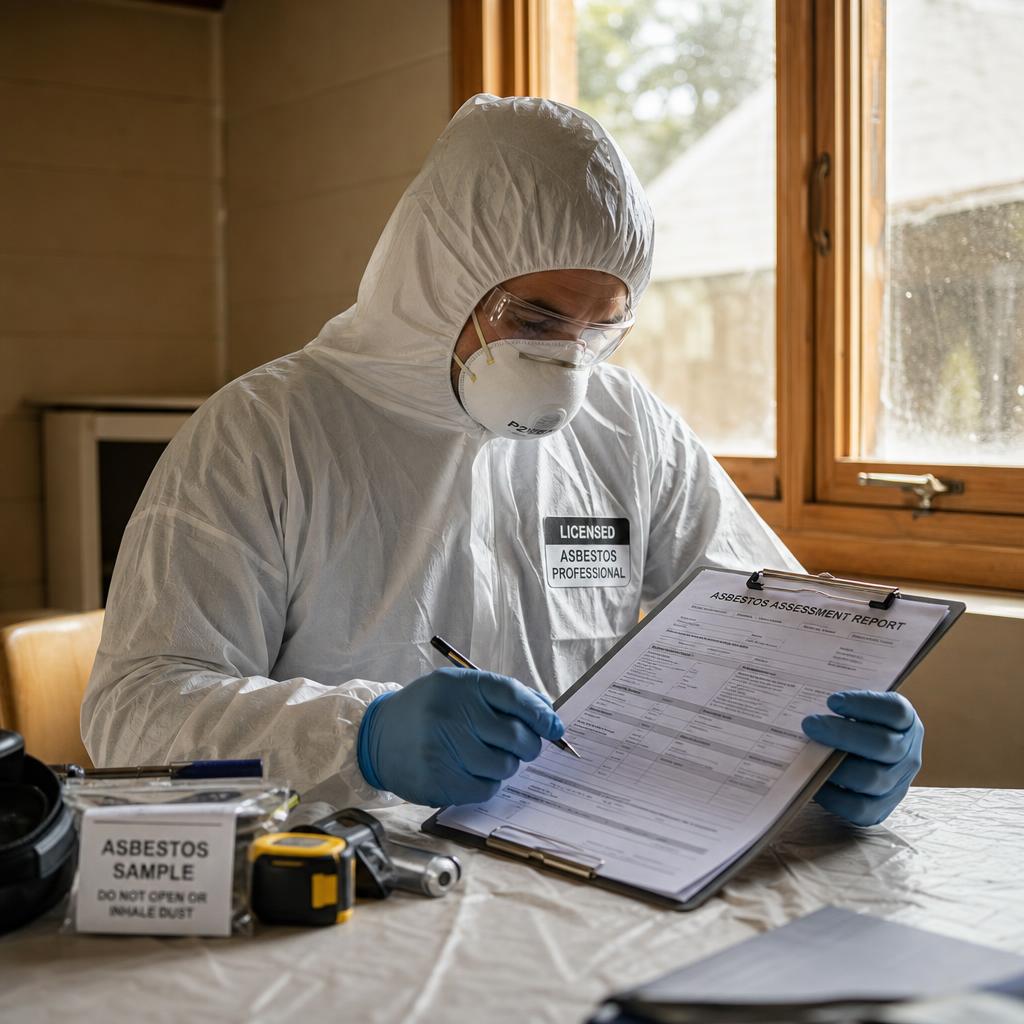
An asbestos inspection or assessment is a survey of an entire property that identifies where asbestos is present, what type it is, what condition it's in, and what should be done about it. In Perth a written residential assessment typically costs between $300 and $800 depending on property size and the number of samples taken. It's most often commissioned before buying an older home, before a renovation, or to meet workplace obligations.
Request a Free On-Site Quote
Leave your details and we'll be in touch to discuss your project.
Asbestos Inspection vs Assessment — Same Service, Different Words
Many Perth property owners search for an "asbestos inspection" while industry professionals and WA regulators more often use the term "assessment" — both describe the same on-site visit: a qualified person examines the property, takes samples of suspect materials, and returns a written report. If you've been searching for an asbestos inspection, an asbestos inspector, or an asbestos assessment, you're looking for the same service under a different name.
Whichever word you use when you call, the process is identical: a site visit, targeted sampling of materials likely to contain asbestos, laboratory analysis, and a written report you can act on. Book an inspection or arrange an assessment — either way, you'll receive the same document described in detail below.
Assessment vs a Single Material Test
Perth Asbestos Removals arranges whole-property asbestos assessments for homebuyers, renovators, landlords and commercial operators across the Perth metro area.
People use the words "assessment" and "testing" interchangeably, but they describe different things. A single test confirms whether one specific material — say, a patch of fibro sheeting or a textured ceiling coating — contains asbestos. An assessment surveys the entire property and produces a documented record of every material found: location, asbestos type (chrysotile, amosite, or crocidolite), bonded or friable classification, condition rating, and recommended action. The assessment report is the whole-of-property picture; the individual test results are its building blocks.
For the sampling procedure, polarised light microscopy (PLM) laboratory analysis, and the testing-vs-clearance comparison, see our asbestos testing and inspection page.
When Perth Property Owners Commission an Assessment
An assessment is most valuable at three specific decision points.
Before Buying
Standard building and pest inspections in WA do not include asbestos identification or sampling. A buyer purchasing a pre-1990 home in suburbs like Armadale, Gosnells, or Balga with no asbestos assessment may inherit a fence, roof, eaves, and internal linings that all require licensed removal — costs that can reach $10,000 to $30,000. An assessment gives buyers a negotiating figure and a removal budget before contracts are signed.
Before Renovating
Any work that involves cutting, drilling, sanding or removing walls, ceilings, floors, eaves, or roof sheeting in a pre-1990 home risks disturbing asbestos-containing materials. Discovering asbestos mid-renovation — after trades are on site and work is under way — means an immediate stop, an emergency assessment, a licensed removal quote, and idle tradespeople waiting. Pre-renovation assessment eliminates that scenario and gives the builder a clear scope from day one.
Workplace and Landlord Obligations
WA occupational safety and health regulations require workplaces to maintain an asbestos register if asbestos is known or reasonably likely to be present. Landlords of commercial tenancies and strata managers of common property have a duty of care to identify and manage asbestos risks for occupants. An assessment is the document that underpins compliance.
What a Whole-Property Survey Covers
In a typical older Perth home, a thorough assessment will examine every location where asbestos-containing materials were commonly used in pre-1990 construction:
Roof sheeting and ridge capping (corrugated cement Super Six sheets)
Eaves and soffits
Boundary fencing (Super Six panels, posts, and footings)
External fibro wall cladding
Internal wall linings and partition sheeting
Ceiling linings and textured coating (friable if spray-applied)
Vinyl floor tiles and adhesive backing
Meter boxes and switchboard linings
Hot water system flue pipes
Contaminated soil around former fence and shed lines
Not all materials will be sampled on every job — the assessor prioritises based on condition, access, and the likelihood of containing asbestos given the age and construction type of the building. Chrysotile (white asbestos) was the most common in WA bonded products; amosite (brown) appeared in some insulation products; crocidolite (blue) is the most hazardous and requires Class A licensed removalists where it is found in friable form.
The Written Assessment Report
The assessment report is the primary deliverable. It is a formal written document that records every material inspected, the sampling result, and the assessor's recommendation. A well-structured report contains:
Material Locations
Exact locations in the property with photographs, so the document is usable by any future tradesperson without a re-inspection.
Asbestos Type and Classification
Whether the material contains chrysotile, amosite or crocidolite, and whether it is bonded (non-friable) or friable — the classification that determines which class of removalist licence is required.
Condition Rating
A scale from undamaged and well-sealed through to damaged and actively releasing fibres. Condition drives the urgency of the recommended action.
Risk Prioritisation
Each item is ranked so the owner can plan removal in a logical order — high-risk and deteriorating materials first, stable bonded materials that can be managed in place last.
Recommended Action
Per-item guidance: leave and monitor, encapsulate, or remove. Removal recommendations reference the 10 square metre threshold that triggers the WorkSafe WA Class B licence requirement for bonded material.
Scope for Removal Quotes
When removal is the outcome, the assessment report becomes the scope document. Removalists quoting from an assessment report provide more accurate prices than those quoting from a walk-through alone.
Keep the report. Future buyers, builders, and tradespeople working on the property will want to see it, and an up-to-date assessment adds measurable value to any older Perth property.
Asbestos Registers and Management Plans
Under WA occupational safety and health regulations, any workplace where asbestos is known or reasonably likely to be present must maintain a written asbestos register. The register records all identified and suspected asbestos-containing materials, their location, condition, and the controls in place to manage the risk.
The register must be reviewed at least every five years, or sooner if the building changes — through renovation, demolition, or change of occupancy. Responsibility sits with the person in control of the workplace, which means commercial landlords, strata managers, and employers in older buildings all carry an obligation.
A management plan goes further: it documents the procedures for dealing with asbestos incidents, the training requirements for workers who may encounter asbestos, and the decision criteria for removal versus encapsulation. For commercial asbestos removal projects, the register and management plan are the starting documents for any scope of work.
Who Needs a Register?
Any person in management or control of a workplace — offices, schools, warehouses, strata common property — where asbestos is present or likely. Residential landlords with commercial tenancies are included.
Review Triggers
Minimum five-year cycle, plus: after any disturbance of asbestos, after partial removal, after significant change to the building fabric, or after any incident where asbestos may have been released.
Air Monitoring
Air monitoring during and after Class A friable removal must be carried out by a licensed asbestos assessor. Clearance certificates for friable work also require an assessor — not just a competent person.
Who Conducts Property Assessments
Assessments and sampling of bonded (non-friable) materials can be carried out by a competent person with appropriate training and equipment — someone with the knowledge, skills, and experience to do the work safely. A licensed asbestos assessor is specifically required for clearance inspections and air monitoring after Class A friable removal work.
For a residential property survey where most materials are bonded — roof sheeting, fibro walls, fence panels — a competent assessor with NATA-accredited laboratory analysis will produce a reliable result. Where any material is suspected to be friable (crumbling, spray-applied textured coatings, pipe lagging), a licensed asbestos assessor should be engaged from the outset.
All assessments arranged by Perth Asbestos Removals are conducted by professionals with appropriate qualifications for the scope of work, using procedures consistent with WorkSafe WA guidance and the WA Code of Practice for the Management and Control of Asbestos in Workplaces.
When Asbestos Is Found — The Removal Pathway
An assessment that finds asbestos is not a crisis — it is a scoping document. The report tells you what is there, how urgent the removal priority is, and what class of licensed removalist is required. This is the information that produces an accurate removal quote.
The two most common removal jobs in Perth following a residential assessment are asbestos fence removal — Super Six boundary fences are the most frequently identified material in the Perth metro — and asbestos roof removal, where weathered corrugated cement sheeting has deteriorated to the point where the risk of fibre release is elevated.
Bonded (non-friable) material in good condition may be left in place and monitored under a management plan. Bonded material that is damaged, crumbling or soon to be disturbed by renovation work requires removal by a Class B licensed removalist. Friable material — damaged insulation, spray-applied coatings, pipe lagging — requires a Class A licensed removalist, stricter containment, and an independent clearance inspection by a licensed assessor before the area can be reoccupied.
Assessment Cost in Perth
Residential whole-property assessments: from $300 to $800+, depending on property size and sample count.
Each laboratory sample carries a real cost — materials, safe handling, transport to a NATA-accredited laboratory, analysis, and the written report. Sampling is never free; free on-site quotes are available before any samples are taken.
Commercial premises, strata properties and large sites are quoted individually after an initial site visit. A large warehouse or multi-building campus is not comparable to a single-storey pre-1990 home in Midland or Swan Valley.
For a comparison of assessment costs against removal costs across all common job types, see our asbestos removal cost guide.